The world of AI art generators has exploded, transforming how we visualize ideas and create digital art. For many, tools like the Magic Studio AI art generator offer an enticing gateway into this brave new creative frontier, promising unique visuals from simple text prompts. But what happens when your creative needs evolve, or you simply wonder if there's something out there that fits your workflow even better?
That's precisely where a deep dive into Magic Studio AI Art Generator: Alternatives & Comparison becomes invaluable. Whether you're a seasoned digital artist, a marketing professional, or just someone looking to conjure captivating images, understanding the broader landscape of AI art tools can unlock new possibilities and refine your artistic process.
At a Glance: Key Takeaways for Choosing Your AI Art Generator
- Magic Studio excels in user-friendliness and offers a solid starting point with free generations, background removal, and object erasure.
- DALL-E 3 (via Bing/Copilot) and Midjourney are top-tier for high-quality, realistic, or artistic text-to-image generation, albeit with different access methods and learning curves.
- Stable Diffusion offers unparalleled customization and local control for those with technical savvy and suitable hardware.
- Adobe Firefly and Canva AI integrate AI art into existing design ecosystems, ideal for designers and marketers.
- Niche tools abound for specific tasks like video generation, e-commerce visuals, face swaps, or advanced photo editing.
- Consider your budget, skill level, desired output quality, and specific feature needs (e.g., video, 3D, editing) when evaluating alternatives.
The AI Art Revolution: Crafting Visions with Code
At its core, AI art generation relies on sophisticated artificial intelligence algorithms, machine learning, and vast datasets of image-text pairs. These systems learn patterns, styles, and concepts, allowing them to interpret your natural language prompts and manifest them as entirely new visual art. From hyper-realistic photographs to fantastical digital paintings, the possibilities are virtually limitless.
Magic Studio has carved out a respectable niche in this space, offering approachable text-to-image capabilities alongside powerful editing tools like background removal and image upscaling. It's a fantastic all-rounder for many users, especially those just dipping their toes into AI-powered creativity. But as the technology matures, so too does the diversity of tools available, each with its own strengths, quirks, and sweet spots.
Why Look Beyond Magic Studio? Finding Your Creative Sweet Spot
While Magic Studio offers a compelling package, exploring alternatives isn't about finding a "better" tool in absolute terms. It's about finding the right tool for your specific needs, budget, and creative ambitions. Here are some common reasons users explore beyond Magic Studio:
- Unrivaled Image Quality or Style: Some generators specialize in photorealism, distinct artistic styles, or cinematic quality that might surpass general-purpose tools.
- Deeper Customization: More advanced users often crave granular control over parameters, models, and workflows.
- Integrated Workflows: Designers might prefer tools integrated directly into their existing creative suites.
- Specific Features: Need to generate video, remove watermarks, create 3D models, or enhance e-commerce product shots? Dedicated tools often do these best.
- Cost-Effectiveness: While Magic Studio offers free generations, its paid plans might not align with everyone's budget for unlimited use, leading users to explore other free tiers or credit systems.
- Privacy & Control: Some users prefer open-source options or local installations for maximum data privacy and ownership.
Understanding these drivers is the first step in navigating the crowded AI art landscape. Let's stack up Magic Studio against the leading players and then explore a galaxy of specialized alternatives.
Top Contenders: Magic Studio Versus the Heavyweights
When comparing AI art generators, we're looking at a blend of image quality, ease of use, feature set, and pricing. Here's how Magic Studio measures up against some of its most prominent competitors:
1. DALL-E 2 / DALL-E 3 (via Microsoft Copilot or Bing Image Creator)
- The Powerhouse: OpenAI's DALL-E models, particularly DALL-E 3, set a high bar for interpreting complex prompts and generating logically coherent, high-quality images. DALL-E 3 is now seamlessly integrated into Microsoft Copilot and Bing Image Creator, making it incredibly accessible.
- Magic Studio vs. DALL-E 3: While Magic Studio is excellent for quick text-to-image and editing, DALL-E 3 often outshines it in understanding nuanced prompts, generating text within images accurately, and producing visually richer, more detailed outputs without much prompt engineering. DALL-E 3's conversational interface through Copilot is also remarkably intuitive.
- Pros: Exceptional understanding of natural language, high-quality outputs, great for intricate scenes, free access via Microsoft accounts.
- Cons: Less direct control over parameters than some others, limited editing capabilities within the generator itself (relies on external tools).
- Best For: Users wanting top-tier image quality and prompt understanding, especially for complex or textual images, integrated seamlessly with everyday search/chat.
2. Midjourney
- The Artist's Favorite: Midjourney, accessible primarily via Discord, is renowned for its cinematic, artistic, and often breathtakingly realistic outputs. It has a distinct aesthetic that many artists gravitate towards.
- Magic Studio vs. Midjourney: Midjourney often produces a more "finished" artistic product with less effort than other tools, though its interface (Discord commands) has a steeper learning curve than Magic Studio's web-based UI. Magic Studio is simpler for basic edits; Midjourney is about pure artistic generation.
- Pros: Unparalleled aesthetic quality, highly artistic and realistic images, active community for inspiration.
- Cons: Discord-centric interface can be off-putting, requires learning specific commands, not free for extensive use (starts at $10/month), no native editing.
- Best For: Artists and designers seeking high-end, distinctive, and often photorealistic imagery; those who enjoy a community-driven environment.
3. Stable Diffusion
- The Open-Source Champion: Stable Diffusion stands out for its flexibility, customizability, and the ability to run locally on consumer hardware (with at least 4 GB VRAM GPU). It's the engine behind many other AI art tools and offers immense power for those willing to dive in.
- Magic Studio vs. Stable Diffusion: Magic Studio offers a curated, user-friendly experience. Stable Diffusion is the wild west: powerful text-to-image, inpainting (editing within an image), outpainting (extending an image), and image-to-image generation. It's significantly more complex but offers creative freedom unmatched by most.
- Pros: Open-source, highly customizable, can be run locally (privacy!), vast ecosystem of models and extensions, powerful editing features.
- Cons: Steep learning curve, requires technical understanding and decent hardware for local use, online versions vary in features and cost.
- Best For: Tech-savvy users, developers, artists who want ultimate control, researchers, and those prioritizing privacy and local processing.
4. Adobe Firefly
- The Design Integration: Adobe Firefly isn't just an image generator; it's a suite of generative AI features designed to integrate seamlessly with Adobe's creative cloud products. Its standout feature is custom text effects and generative fill.
- Magic Studio vs. Adobe Firefly: Magic Studio is a standalone tool for quick generations and basic edits. Firefly is part of a professional ecosystem, excelling at creating custom text styles and non-destructive image manipulation within Photoshop or Illustrator. If you live in the Adobe ecosystem, Firefly is a natural extension.
- Pros: Deep integration with Adobe Creative Cloud, excellent for text effects and generative fill, commercially safe content.
- Cons: Primarily for Adobe users, not a standalone general-purpose art generator in the same vein as Midjourney or DALL-E.
- Best For: Graphic designers, photographers, and creatives already using Adobe products who want AI assistance within their existing workflow.
5. Canva
- Design for Everyone: Canva, the popular template-based design platform, now includes a text-to-image AI art generation feature (powered by Stable Diffusion).
- Magic Studio vs. Canva AI: Magic Studio focuses purely on image generation and basic photo editing. Canva's AI tool is one feature within a vast design platform. If you need to generate an image and then immediately integrate it into a poster, social media graphic, or presentation, Canva offers a streamlined workflow.
- Pros: Integrated into an easy-to-use design platform, great for non-designers, free tier available for basic use.
- Cons: AI generation quality might not match dedicated tools, advanced features require a paid subscription ($12.99/month).
- Best For: Marketers, small business owners, social media managers, and anyone needing quick designs with integrated AI image generation.
6. Night Cafe
- The Model Mixer: Night Cafe distinguishes itself by allowing users to choose from multiple AI art models (Stable Diffusion, DALL-E 2, CLIP-Guided Diffusion, VQGAN-CLIP) to achieve optimal results.
- Magic Studio vs. Night Cafe: Magic Studio provides a single, streamlined experience. Night Cafe offers more experimental control by letting you select underlying models, which can lead to more varied or specific stylistic outcomes. It's a great intermediate step for those who want more control than a simple generator but aren't ready for local Stable Diffusion.
- Pros: Access to multiple generative models, good for experimentation, decent credit system for paid users.
- Cons: Interface can be a bit busy, output quality depends heavily on model choice and prompt engineering.
- Best For: Experimenters, artists who want to try different AI styles, and those looking for a web-based platform with model flexibility.
7. Craiyon (formerly DALL-E mini)
- The Accessible Experimenter: Craiyon is known for its user-friendly interface and commitment to free image generation. It gained popularity as "DALL-E mini" and has continually improved its performance.
- Magic Studio vs. Craiyon: Magic Studio offers more polished results and additional editing features. Craiyon, while improved, is still more geared towards quick, fun, and often quirky generations. It's less about high-fidelity output and more about accessible experimentation.
- Pros: Completely free, very easy to use, fun for quick ideas.
- Cons: Image quality can be inconsistent, less precise than DALL-E 3 or Midjourney.
- Best For: Beginners, casual users, and those looking for a free and fun way to generate quick AI images without high expectations for realism or detail.
8. Image FX
- Google's Creative Offering: Image FX, accessible with a Google account, provides four result images per prompt and includes unique "expressive chips" for refining prompts.
- Magic Studio vs. Image FX: Both offer intuitive user interfaces. Image FX's "expressive chips" provide a novel way to guide the AI without complex prompt engineering, making it a strong contender for beginners looking for creative control. Its free access with a Google account is also a major plus.
- Pros: Free with Google account, user-friendly, "expressive chips" aid prompt definition, good for beginners.
- Cons: May not match the absolute highest quality of paid specialized tools.
- Best For: Google users, beginners who appreciate guided prompt creation, and those seeking a free, easy-to-use image generator for creative exploration.
Beyond Text-to-Image: Niche AI Alternatives for Every Creative Need
The world of AI-powered image tools extends far beyond simple text-to-image generation. Many alternatives to Magic Studio offer specialized functionalities that can drastically streamline specific tasks or unlock entirely new creative avenues.
For Advanced Image Editing & Enhancement
Sometimes you don't need to generate a new image; you need to perfect an existing one. These tools take common photo editing tasks and supercharge them with AI:
- Magic Eraser & ClipDrop: Specializing in removing unwanted objects, people, or text from photos quickly and cleanly. Pixelcut also offers object erasure alongside background removal and upscaling.
- Vance AI & Let's Enhance: Focus on upscaling images, denoising, sharpening, and generally improving photo quality without losing detail. Imglarger and Topaz Labs also excel in this area.
- Photify AI: Enhances, edits, and transforms images with advanced automation and creative filters.
- Photo Editor AI: Automates enhancement, retouching, and transformation with features like background removal and face correction.
For Video & Motion Art Generation
The frontier of AI is rapidly expanding into motion. If static images aren't enough, consider these:
- Gen-2 by Runway: A leader in AI-powered video generation, turning text or images into dynamic video clips.
- DomoAI: Transforms text, images, and videos into stylized motion art, including anime and photorealistic animations.
- LensGo AI: Generates high-quality images and videos using advanced text-to-video models.
- PixaMotion: Specializes in transforming static photos into dynamic, looping motion images.
- Imagine Anything & Straico: Offer comprehensive suites that generate images, videos, audio, and even music from text prompts, creating rich multimedia experiences.
For E-commerce & Business Visuals
Businesses, especially in e-commerce, have unique visual needs that AI can address with stunning efficiency:
- SellerPic, Pixelcut & ZMO AI: Generate professional product images, lifestyle scenes, remove backgrounds, and even showcase products on virtual models.
- Wondershare VirtuLook & Niia.AI: Create realistic product photos, place items on virtual models, and generate apparel designs for fashion and e-commerce.
- VISBOOM: An all-in-one platform for e-commerce visuals, replacing traditional photoshoots with AI clothes changers, model swaps, and text-to-image generation.
- Flair AI: Helps businesses generate branded marketing assets with unique templates and intelligent customization.
- Foxy AI: Streamlines property image enhancement for real estate.
- Stockimg.ai: Creates high-quality images, logos, posters, and book covers specifically from text prompts, perfect for marketing content.
For Specialized Generation (3D, Characters, Adult Content, etc.)
Some tools cater to very specific or niche creative demands:
- Leonardo.AI: Generates high-quality images and videos using advanced generative AI tools, particularly strong for gaming and marketing assets.
- AliveAI & Promptchan AI: Offer uncensored or adult-oriented image/video generation with customizable characters and styles (users should exercise discretion).
- Human Generator: Creates fully rigged realistic human models for 3D environments like Blender.
- AI Funko Pop Generator: A unique tool to create custom Funko Pop figurine designs from text.
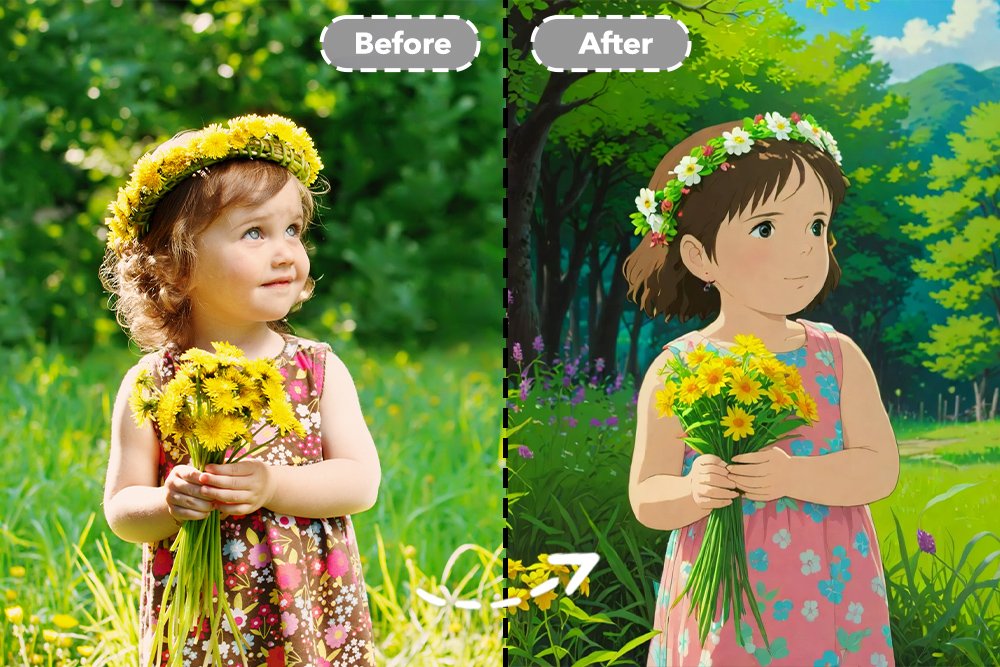
- Ghibli Style: Transforms images into dreamy, hand-painted visuals inspired by Studio Ghibli.
- Dzine AI: Offers image generation, editing, background removal, 2D-to-3D conversion, and AI character creation.
For Developer & API Integration
For those who want to build their own AI applications or integrate AI art into existing systems:
- Replicate & Fal.ai: Cloud platforms for developers to deploy and integrate machine learning models via API, offering fast, serverless solutions for custom models and generative media.
- Stable Horde: A community-driven, open-source project that pools GPU resources for scalable and cost-efficient image and text-to-image generation.
- Vertex AI: While a broader chatbot platform, it simplifies machine learning workflows from data preparation to deployment, applicable to custom image generation models.
For Face Manipulation & Avatars
Face-swapping, look-alike matching, and avatar creation have become increasingly sophisticated:
- Star By Face: Matches users' faces with celebrity look-alikes using facial recognition.
- Swapface.org & SeaArt Faceswap & DeepSwapper AI & Face Swap by Akool & Video Face Swap AI: Offer real-time or static face-swapping in images, videos, and live streams with hyperrealistic results.
- Lucidpic: Transforms selfies into professional-quality images and videos, creating avatars and headshots.
- Qoves: Uses AI for cosmetic facial assessments, providing detailed reports and recommendations.
For Design & Creative Workflows
Tools that integrate AI into broader design processes or offer unique creative aids:
- Microsoft Designer & Ideogram: AI-powered design platforms for crafting professional visuals, logos, and social media graphics, with Ideogram specifically excelling at accurate text rendering in graphics.
- Kittl: An easy-to-use image platform with templates, advanced editing, and scalable vector graphics for designers.
- AutoDraw: A free Google tool that transforms rough sketches into professional-looking graphics.
- Scribble Diffusion: Turns rough sketches into polished digital art.
- Artbreeder: Helps artists blend images and experiment with "genetics" to produce unique artworks.
- The AI Character Generator by Boords: Creates consistent characters for storyboards without drawing skills.
This extensive list demonstrates that while Magic Studio is a strong generalist, the specialized tools often provide deeper functionality and superior results for very specific use cases.
Choosing Your AI Art Co-Pilot: Key Considerations
With so many options, how do you pick the right one? Here's a framework to guide your decision:
1. Cost vs. Free Tiers
- Free-to-Start: Many tools, including Magic Studio, DALL-E 3 (via Bing/Copilot), Image FX, Craiyon, and Stable Horde, offer free generations or credits. This is a fantastic way to experiment.
- Subscription Models: Midjourney, Night Cafe, Canva, and many others operate on monthly subscriptions or credit packs. Evaluate your expected usage against the cost.
- Pay-As-You-Go: Some developer-focused platforms like Replicate charge based on API usage, which can be cost-effective for intermittent heavy use.
- Local Hardware Investment: Running Stable Diffusion locally is "free" in terms of ongoing subscription, but requires an upfront investment in a capable GPU.
2. Ease of Use & Learning Curve
- Beginner-Friendly: Magic Studio, Bing Image Creator, Craiyon, Canva, and Image FX offer intuitive interfaces that require minimal technical knowledge.
- Intermediate: Night Cafe, DALL-E 2, and some online Stable Diffusion interfaces offer more options but are still manageable.
- Advanced/Technical: Midjourney (Discord commands), raw Stable Diffusion (especially local installations), and developer APIs (Replicate, Fal.ai) have steeper learning curves but offer immense power.
3. Output Quality & Style
- Photorealism: Midjourney, DALL-E 3, and well-tuned Stable Diffusion models excel here.
- Artistic/Stylized: Midjourney is famous for its unique aesthetic. Tools like Night Cafe and those offering specific style transfers (e.g., Ghibli Style) cater to this.
- Coherence & Prompt Understanding: DALL-E 3 is particularly strong at interpreting complex and lengthy prompts accurately.
- Specific Needs: If you need text within an image, DALL-E 3 and Ideogram are good bets.
4. Specific Features
- Text-to-Image: Almost all offer this, but the quality varies.
- Image-to-Image / Inpainting / Outpainting: Stable Diffusion and more advanced photo editors excel here.
- Background Removal / Object Erase: Magic Studio, Pixelcut, ClipDrop, Cutout Pro, BGBye are strong contenders.
- Video Generation: Gen-2 by Runway, DomoAI, LensGo AI are dedicated tools.
- 3D Models: Leonardo.AI, Human Generator.
- E-commerce Specifics: SellerPic, VISBOOM, ZMO AI.
5. Community & Support
- Active Communities: Midjourney, with its Discord server, has a thriving and helpful community. Stable Diffusion also benefits from a vast open-source community.
- Official Support: Larger companies like Microsoft (for DALL-E 3 via Bing/Copilot) and Adobe provide robust customer support.
6. Privacy & Ownership
- Data Usage: Understand how your prompts and generated images are used by the platform. Many state they may use them for model training (check terms of service).
- Open-Source vs. Proprietary: Open-source tools like Stable Diffusion often offer more transparency and local control.
- Commercial Use: Ensure the terms of service allow you to use your generated art for commercial purposes, especially if you plan to sell it or use it in marketing.
Navigating the AI Art Landscape: Tips for Success
The journey into AI art is an exciting one, but a few pointers can smooth the path:
- Master the Prompt: "Prompt engineering" is the art of crafting effective text inputs. Be descriptive, specify styles, moods, lighting, and even camera angles. Experiment with negative prompts (what you don't want).
- Iterate and Experiment: Don't expect perfection on the first try. Generate multiple versions, refine your prompts, and learn how each tool responds.
- Combine Tools: You don't have to stick to just one. Generate a base image in Midjourney, then take it to Magic Studio for background removal, and finally enhance it in Vance AI.
- Stay Updated: The AI art space evolves at lightning speed. Keep an eye on new models, features, and research.
- Be Mindful of Ethics: Understand the ethical implications of AI art, including data sourcing, potential biases, and intellectual property.
Your Next Creative Leap
Whether you're sticking with Magic Studio for its balanced approach or venturing into the specialized realms of Midjourney's artistry, DALL-E 3's precision, or Stable Diffusion's boundless customization, the key is to match the tool to your vision. Each platform offers a unique lens through which to explore the infinite possibilities of AI-driven creativity.
Take some time to try out the free tiers, consider your most frequent creative challenges, and evaluate which "co-pilot" will best help you bring your imaginative concepts to life. The perfect AI art generator isn't just a tool; it's an extension of your creative spirit, ready to render your wildest ideas into stunning visuals.